How Digital Transformation Is Driving ISO 27001 Adoption Across Industries economy

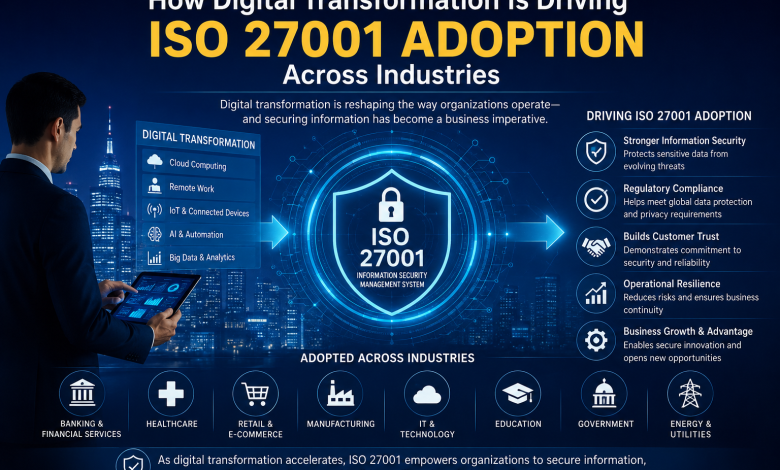
How Digital Transformation Is Driving ISO 27001 Adoption Across Industries economy.
Introduction
A typical digitalized economy, information is one of the most valuable assets an organization possesses. From customer data and financial records to intellectual property and operational systems, the security of information determines the resilience and credibility of a business.
Cyber threats, data breaches, ransomware attacks, and regulatory scrutiny have significantly increased the need for structured information security management. Organizations can no longer rely on ad-hoc security practices; they must adopt internationally recognized frameworks that demonstrate accountability, resilience, and compliance.
One of the most widely recognized frameworks addressing this need is ISO/IEC 27001, the global standard for Information Security Management Systems (ISMS).
ISO 27001 provides a systematic approach to managing sensitive information so that it remains secure through risk management, governance, internal control mechanisms, and continuous improvement.
For organizations seeking to strengthen trust, ensure regulatory compliance, and improve operational resilience, ISO 27001 certification is rapidly becoming a strategic necessity rather than a technical option.
Understanding ISO 27001
ISO 27001 establishes the requirements for implementing, maintaining, and continually improving an Information Security Management System (ISMS).
An ISMS is a structured framework consisting of:
- Policies and procedures
- Risk assessment processes
- Security controls
- Monitoring and performance evaluation mechanisms
- Continual improvement processes
The standard ensures organizations manage three core principles of information security:
Confidentiality – ensuring information is accessible only to authorized individuals
Integrity – safeguarding the accuracy and completeness of information
Availability – ensuring information and systems remain accessible when required
Organizations implementing ISO 27001 establish systematic controls to protect information assets against both internal and external threats.
Why ISO 27001 Matters for Modern Organizations
Businesses today operate within a complex digital environment that includes:
- Cloud infrastructure
- Remote workforce
- Third-party vendors
- Digital financial transactions
- Regulatory data protection obligations
Without a structured security framework, organizations are exposed to:
- Data breaches
- Operational disruption
- Legal liabilities
- Loss of stakeholder trust
- Regulatory penalties
ISO 27001 addresses these challenges by establishing a risk-based security management system rather than isolated security technologies.
The framework ensures that security decisions are driven by organizational risk assessment and strategic management oversight.
Core Structure of ISO 27001
ISO 27001 follows the Annex SL High-Level Structure, making it compatible with other management system standards.
Key clauses include:
Context of the Organization
Organizations must identify internal and external factors affecting information security, including regulatory obligations, business objectives, and stakeholder expectations.
Leadership
Top management must demonstrate commitment by establishing information security policies, allocating resources, and integrating security into corporate governance.
Planning
Organizations conduct information security risk assessments to identify threats, vulnerabilities, and potential impacts.
Risk treatment plans are then developed to mitigate identified risks.
Support
This includes:
- Competence and training
- Awareness programs
- Documented information
- Communication mechanisms
Operation
Operational controls are implemented to ensure effective management of information security risks.
Performance Evaluation
Organizations must conduct:
- Internal audits
- Management reviews
- Performance monitoring
Improvement
Corrective actions and continual improvement processes ensure the ISMS evolves with emerging threats and organizational changes.
The Role of Audit in ISO 27001 Certification
Audit assessment is the backbone of ISO 27001 compliance.
Audits verify that an organization’s information security management system is not merely documented but effectively implemented and operationally controlled.
Three key audit stages typically occur:
Internal Audit
Internal audits evaluate the organization’s preparedness and effectiveness of ISMS controls.
These audits verify:
- Risk assessment processes
- Control implementation
- Incident response capability
- Policy adherence
Internal audits provide management with critical insight into vulnerabilities and operational weaknesses before external assessment.
Certification Audit
Independent certification bodies conduct a two-stage audit process.
Stage 1 – Readiness Review
The auditor evaluates:
- ISMS documentation
- Risk assessment methodology
- Scope of the management system
- Organizational preparedness
Stage 2 – Certification Audit
Auditors assess:
- Implementation effectiveness
- Security control performance
- Evidence of operational compliance
- Staff awareness and competence
Only organizations demonstrating systematic risk management and effective controls achieve certification.
Surveillance Audits
After certification, organizations undergo annual surveillance audits to ensure continued compliance and improvement.
This reinforces the credibility of ISO certification and ensures organizations maintain robust security governance.
Strategic Business Benefits of ISO 27001
Beyond compliance, ISO 27001 offers significant strategic advantages:
Enhanced Market Credibility
Certification demonstrates to customers, regulators, and investors that the organization operates within internationally recognized security standards.
Stronger Customer Trust
Organizations handling sensitive information—especially in sectors like finance, healthcare, technology, and government contracting—gain increased confidence from stakeholders.
Competitive Market Advantage
Many global contracts now require ISO 27001 certification as a mandatory qualification criterion.
Operational Risk Reduction
Through structured risk management, organizations minimize the likelihood and impact of security incidents.
Why Forward-Thinking Organizations Are Investing in ISO 27001
Cybersecurity threats continue to evolve at an unprecedented pace. Organizations that treat information security as a strategic governance issue—not merely a technical function—are better positioned to maintain operational continuity and stakeholder trust.
ISO 27001 certification signals to the market that the organization operates with discipline, accountability, and international best practices in information security management.
For organizations seeking to secure their digital infrastructure and strengthen market credibility, ISO 27001 represents a powerful foundation for resilient and trusted business operations.
Information Security Risks and ISO 27001 Audit Compliance: What Organizations Must Understand
Introduction
Information security risks are no longer hypothetical threats. Organizations across industries are increasingly facing cyberattacks, insider threats, system vulnerabilities, and regulatory scrutiny related to data protection.
A single security incident can result in severe consequences including financial loss, reputational damage, regulatory penalties, and operational disruption.
To address these challenges, organizations worldwide adopt **ISO/IEC 27001 as a structured framework for identifying, assessing, and mitigating information security risks.
However, achieving certification is only part of the journey. Sustained compliance requires robust audit governance, risk monitoring, and continual improvement mechanisms.
Understanding Information Security Risks
Information security risks arise when threats exploit vulnerabilities in an organization’s systems, processes, or human behavior.
Common categories of risks include:
Cyber Threats
External attackers may exploit system vulnerabilities to gain unauthorized access to sensitive information.
Examples include:
- Phishing attacks
- Ransomware
- Malware infiltration
- Network intrusion
Insider Risks
Employees, contractors, or partners may intentionally or unintentionally compromise sensitive information.
This may occur through:
- Unauthorized data sharing
- Weak password practices
- Misuse of access privileges
Third-Party Risks
Organizations increasingly rely on vendors, cloud providers, and outsourcing partners.
Weak security practices among third parties can expose organizations to data breaches and operational disruption.
Regulatory and Legal Risks
Data protection laws and privacy regulations impose strict obligations regarding information security.
Failure to comply may lead to fines, sanctions, and litigation.
Risk Assessment in ISO 27001
ISO 27001 requires organizations to conduct structured information security risk assessments.
The process includes:
- Identification of information assets
- Identification of potential threats
- Identification of system vulnerabilities
- Evaluation of likelihood and impact
- Determination of risk levels
Based on the assessment, organizations develop risk treatment plans that include:
- Implementing security controls
- Accepting low-level risks
- Transferring risks through insurance or outsourcing
- Eliminating vulnerabilities
This risk-based approach ensures security investments are directed where they are most needed.
ISO 27001 Audit Compliance
Audit compliance ensures that the organization’s information security management system operates effectively.
ISO 27001 audits evaluate:
- Implementation of security policies
- Risk assessment methodology
- Access control mechanisms
- Incident management procedures
- Employee awareness and competence
- Documentation and record keeping
Auditors assess objective evidence to confirm that security controls are functioning as intended.
Key Areas Examined During ISO 27001 Audits
Professional auditors typically examine the following critical domains:
Information Security Governance
- Security policies and procedures
- Leadership commitment
- Allocation of security responsibilities
Risk Management Framework
- Risk identification methodology
- Risk evaluation criteria
- Risk treatment plans
Access Control Systems
- User authentication mechanisms
- Role-based access privileges
- Identity management practices
Incident Response Capability
- Security incident reporting procedures
- Incident response teams
- Post-incident analysis and corrective action
Business Continuity and Disaster Recovery
Organizations must demonstrate that information assets remain protected during disruptions.
The Strategic Importance of Compliance Audits
Compliance audits are often perceived as regulatory exercises. However, forward-looking organizations recognize audits as strategic risk management tools.
Audits provide:
- Independent verification of security practices
- Early detection of vulnerabilities
- Opportunities for system improvement
- Assurance to stakeholders and regulators
Organizations that treat audits as opportunities for improvement rather than administrative obligations tend to achieve stronger security resilience.
Marketing Advantage of ISO 27001 Compliance
In an increasingly security-conscious business environment, ISO 27001 certification has also become a powerful market differentiator.
Companies that maintain ISO 27001 certification can confidently communicate that their information security practices align with international best practices.
This provides a strong competitive advantage in sectors such as:
- Financial services
- Telecommunications
- Cloud computing
- Government contracting
- International trade
Certification signals to clients that the organization has undergone independent audit verification and operates under a disciplined information security governance framework.
Conclusion
Information security risks continue to evolve alongside technological innovation and digital transformation. Organizations that fail to adopt structured risk management frameworks risk falling behind both operationally and competitively.
ISO 27001 provides a globally recognized framework that enables organizations to systematically manage information security risks while demonstrating accountability and transparency through rigorous audit processes.
By integrating risk management, audit governance, and continual improvement, organizations can transform information security from a technical function into a strategic pillar of corporate resilience and market credibility.